How many calories should I eat a day? (2026 guide)
Most adults need about 1,600–3,000 calories a day. Work out your own number in three simple steps, then adjust it to lose, maintain or gain weight.
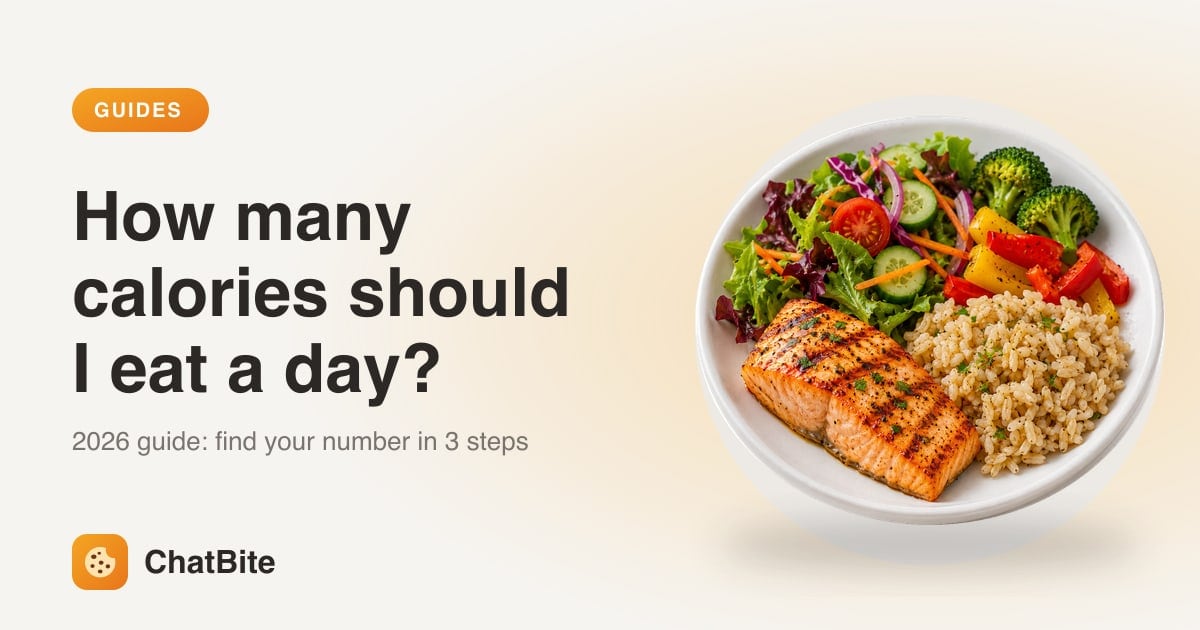
Most adults need somewhere between about 1,600 and 3,000 calories a day. As a rough guide, the UK's NHS uses about 2,000 calories for women and 2,500 for men, but your own number depends on your size, age, sex and how active you are. This 2026 guide shows you how to work out your number in three steps, how to adjust it to lose, maintain or gain weight, and how to check it against real life.
How many calories do adults need on average?
The US Dietary Guidelines estimate that adult women need roughly 1,600 to 2,400 calories a day and adult men roughly 2,000 to 3,000. The low end fits people who are smaller, older or mostly sitting; the high end fits people who are taller, younger or very active.
| Adults aged 19–60 | Not active | Active |
|---|---|---|
| Women | 1,600–2,000 kcal | 2,200–2,400 kcal |
| Men | 2,200–2,600 kcal | 2,600–3,000 kcal |
These are averages for whole populations. Two people of the same age and sex can need several hundred calories apart, which is why it's worth working out your own estimate.
Step 1: Estimate the calories you burn at rest
Your body burns energy just to keep you alive, even at rest. The most widely used formula to estimate it is the Mifflin–St Jeor equation, which a review by the Academy of Nutrition and Dietetics found to be the most accurate of the common equations:
- Men: 10 × weight in kg + 6.25 × height in cm − 5 × age + 5
- Women: 10 × weight in kg + 6.25 × height in cm − 5 × age − 161
- Using pounds and inches? Multiply pounds by 0.454 for kg and inches by 2.54 for cm first.
Example: a 35-year-old woman who is 165 cm tall and weighs 68 kg: 10 × 68 + 6.25 × 165 − 5 × 35 − 161 = 680 + 1,031 − 175 − 161 ≈ 1,375 calories a day at rest.
Step 2: Multiply by your activity level
Next, multiply that number by an activity factor to estimate the calories you burn on a normal day, often called your maintenance calories. These are the commonly used factors:
| Your typical day | Multiply by |
|---|---|
| Mostly sitting, little exercise | 1.2 |
| Light exercise 1–3 days a week | 1.375 |
| Moderate exercise 3–5 days a week | 1.55 |
| Hard exercise 6–7 days a week, or an active job | 1.725 |
Our example woman exercises about four days a week: 1,375 × 1.55 ≈ 2,130 calories a day to stay at her current weight. A 30-year-old man who is 178 cm and 82 kg and lightly active would land at about 1,788 × 1.375 ≈ 2,460.
Step 3: How many calories should I eat to lose weight?
To lose weight, eat less than your maintenance number. A deficit of about 500 calories a day typically leads to losing around 0.5 kg (about 1 lb) a week; UK guidance from NICE uses a deficit of about 600. Slower is easier to keep up and protects muscle, especially if you eat enough protein.
| Goal | Daily target | Our example woman |
|---|---|---|
| Lose weight | Maintenance − 500 | about 1,630 kcal |
| Maintain | Maintenance | about 2,130 kcal |
| Build muscle | Maintenance + 250 to 300, with strength training | about 2,380–2,430 kcal |
Don't go too low. Unless a doctor is supervising you, health experts generally advise women not to go below about 1,200 calories a day and men not below about 1,500, because it becomes hard to get enough nutrients and keep muscle.
Why do calorie calculators give different answers?
Calculators use different equations, and the biggest variable is the activity level you pick. Even the best formula is an estimate: in studies, Mifflin–St Jeor lands within about 10% of measured values for most people but misses by more for some. Treat any calculator's number as a starting point, not a verdict.
How to check your number against real life
- Eat at your estimated target for 2 to 3 weeks and log your meals honestly, including drinks, oil and snacks.
- Weigh yourself a few mornings a week, under the same conditions, and look at the weekly average rather than single days.
- If your weight is stable, that's your real maintenance. If you're losing about 0.5 kg a week on your “lose” target, it's working.
- Adjust in small steps of about 100 to 200 calories, then give it another two weeks.
Weight loss also tends to slow as you get lighter, because a smaller body burns less. Re-check your numbers every 5 kg or so.
What should those calories be made of?
Calories decide your weight; what they're made of decides how full, strong and healthy you feel. Prioritise protein (most people losing weight do well on about 1.2 to 1.6 g per kg of body weight), get 25 to 38 g of fiber a day, and fill half your plate with vegetables. Our guides on protein, fiber and making calorie counting easier go into each of these in detail.
The easy way to hit your number
ChatBite is an AI calorie and protein coach that works inside WhatsApp and Telegram: you send a photo, a few words or a voice note, and it logs your meal and tracks your day. When you start, it asks a few quick questions and calculates your daily calorie and protein targets with the Mifflin–St Jeor equation used in this guide, including the safe minimums. After that, every meal shows how much of your day is left, and you can change your goal at any time by just saying so.
How many calories should I eat a day?
Most adults need about 1,600 to 3,000 calories a day. Work out your own number with the Mifflin–St Jeor equation and your activity level, then adjust for your goal.
How many calories should I eat to lose weight?
About 500 calories less than your maintenance number, which usually leads to losing around 0.5 kg (1 lb) a week. Most women shouldn't go below about 1,200 calories and most men below about 1,500 without medical supervision.
Is 2,000 calories a day a lot?
It's about average for a moderately active woman and on the low side for many men. Whether it's right for you depends on your size, age and activity.
What are maintenance calories?
The number of calories you burn on a typical day, so eating that amount keeps your weight stable.
Why am I not losing weight on my calorie target?
Usually because the estimate or the logging is off. Log everything for two weeks, including oil, drinks and snacks, then lower your target by 100 to 200 calories if your weight hasn't moved.
Sources: Dietary Guidelines for Americans; NHS; NICE (UK National Institute for Health and Care Excellence); Mifflin et al., American Journal of Clinical Nutrition (1990); Academy of Nutrition and Dietetics Evidence Analysis Library; Harvard Health Publishing.
This article is general information, not medical advice. If you're pregnant or breastfeeding, have a medical condition, or have a history of disordered eating, talk to a doctor or registered dietitian before setting a calorie target.
Values are typical estimates for home-style food and vary by recipe and portion. This is general information, not medical advice.
Put it into practice
Snap your next meal and ChatBite does the maths. Free for 7 days, no card needed.